
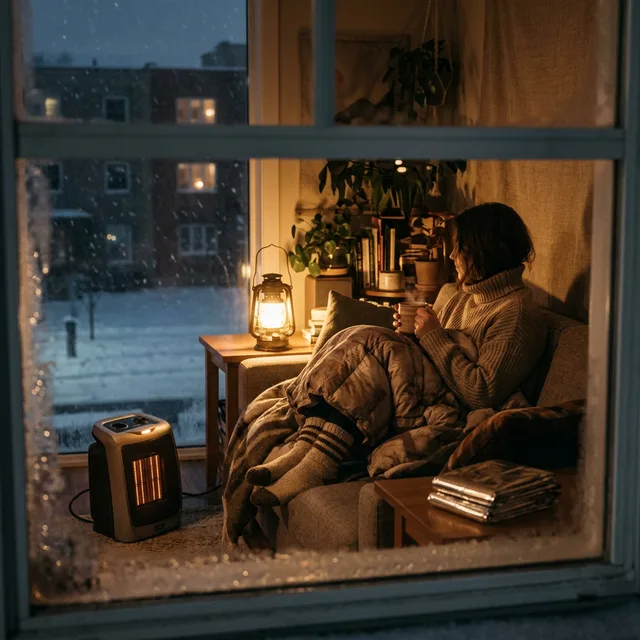
During a severe winter storm, a power outage shuts off the heat in most apartments, and every room cools hour by hour.
If you don’t have a roaring fireplace or a gas generator—which are impossible and dangerous in an apartment setting—you must rely on the physics of insulation and body heat. For the full plan covering food, water and communication, see what to do when the power goes out. Here are the life-saving steps to stay warm when the thermostat drops to zero.
1. Shrink Your Living Space (The Micro-Environment)
It is impossible to heat a 900-square-foot apartment using body heat. Therefore, you must make your living space dramatically smaller.
Pick the smallest interior room in your apartment (usually a bedroom or a large walk-in closet with no exterior walls). Move all your supplies, family members, and pets into this room. Close the door, and place a rolled-up towel under the door gap to halt drafts. You are now trying to heat 100 square feet instead of 900.
💡 TIP: The Indoor Tent Hack
Set up a cheap 2-person camping tent directly on top of your mattress. Sleeping inside the closed tent traps your body heat in a small space, so the air around you stays warmer than the room.
2. Seal the Envelope
Windows are massive thermal leaks. Even double-paned glass bleeds heat. Take thick blankets, comforters, or even bubble wrap, and tape them directly over the windows. The darker the blanket, the better, though you may want to open them on the south side for an hour during peak daylight to let solar radiation in, then seal them tightly before sunset.
3. The Layering System (Not All Clothes Are Equal)
Throwing on three heavy sweatshirts will actually make you colder if you start to sweat. You need a systematic approach to layering:
- Base Layer (Moisture Wicking): Wool or synthetic thermals against the skin. Never cotton. Cotton absorbs sweat, dries slowly, and pulls heat away from your skin.
- Middle Layer (Insulation): Fleece, down jackets, or thick wool sweaters. This layer traps dead air, which is what actually keeps you warm.
- Outer Layer (Wind/Water Block): Not strictly necessary indoors, but a windbreaker can help block persistent drafts.
4. Heat Your Body, Not the Room
Keep grills, camp stoves, propane heaters and the gas oven out of your heating plan. Ready.gov and the CDC both say never to heat your home with a gas stove or oven, and camp stoves and grills belong outdoors. Every flame indoors adds carbon monoxide to the air you are sealing in.
Heat that burns no fuel works in any apartment:
- A heated throw or electric blanket on a power station. It draws a small fraction of a space heater’s power. Even on a station whose AC output is rated to run it, a 1,500-watt space heater empties 1,000 Wh in under an hour; a heated throw runs for hours on the same station.
- Rechargeable hand warmers, topped up from a power bank.
- A sleeping bag rated for cold weather, on top of your bed.
- A battery carbon monoxide alarm outside the bedroom. Our apartment CO detector guide shows which models keep working in an outage.
5. The Hot Water Bottle Trick
Heat a pot of water on your gas stovetop, lit by hand with a window cracked, then turn the burner off; our indoor emergency cooking guide covers the setup. An electric kettle on a power station works too. Fill a rubber hot water bottle or a heavy-duty Nalgene bottle with hot, not boiling, water, and check that the cap seals. Wrap it in its cover or a towel so it never touches bare skin, then hold it against your core or tuck it under the blankets.
Shrink your space, layer smartly, skip cotton, and keep every flame out of the heating plan. Our budget apartment preps guide covers a low-cost cold-weather kit.